


Project Overview: New Tashkent Construction Efficiency Transformation
The Tashkent New City Project was born against the background of Uzbekistan’s strong promotion of the “New Tashkent” national strategic urban expansion plan and has become a major turning point for the construction of modern infrastructure in Central Asia. Orient GS International Engineering Co., Ltd. produced and provided the project, which ultimately serves the self-construction and operation of the New Tashkent region.
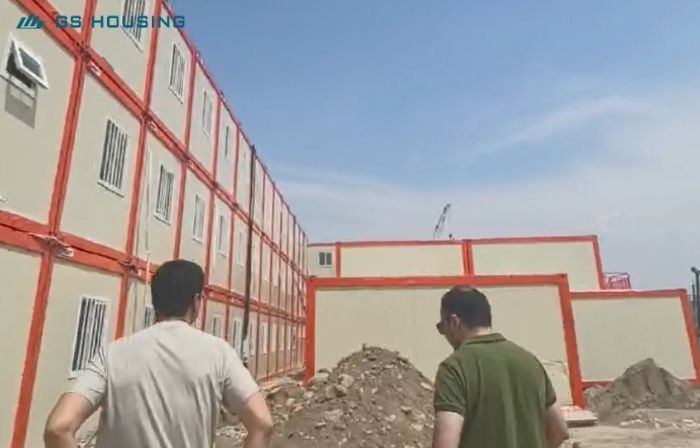
The main deliverable of the project is 182 prefabricated modular buildings of high quality. These modular units are not just temporary housing but multifunctional building systems that combine worker accommodation, offices, restaurants, laundry rooms, stairs, and corridors. All the prefab modules are exported from GS Housing’s Foshan factory and come with a 12-month quality guarantee, fully demonstrating the reliability and competitiveness of Chinese manufacturing in the international infrastructure sector.
Project Background: Why Is Tashkent Need Modular Buildings?
Uzbekistan’s economy has been the fastest-growing in Central Asia since its reform and opening up in 2017. The capital, Tashkent, is under triple pressure from a fast-growing population, housing shortages, and old infrastructure. In 2023, President Mirziyoyev launched the “New Tashkent” project, which aims to create a modern new district east of the existing city that can house a million people. Traditional reinforced concrete construction methods are time-consuming, costly, and have a huge environmental impact, which makes them not suitable for the fast development of the new city.
The best solution has become the prefabricated modular building from China. The factory can produce 182 modular units in parallel, completing electrical pre-installation, insulation installation, interior decoration, and exterior decoration simultaneously. On-site construction is limited to foundation work and lifting and assembly of modules. This “factory manufacturing + on-site assembly” model shortens the overall construction period by more than 50%, reduces construction waste by 70%, and is perfectly in line with the local labor force and technical capabilities in Uzbekistan.


China Prefab Buildings Technical Highlights: A Comprehensive Guide from Frame to Electrical
1. Galvanized Cold-Formed Steel Frame – 20 Year Structural Life
All primary module structures are constructed from high-quality galvanized cold-formed steel. This material is processed in a continuous cold-forming process so that high cross-sectional efficiency and a lightweight but strong load-bearing capacity are achieved. The thickness of the galvanized layer is strictly according to ISO 1461 and gives reliable protection against corrosion caused by condensation, which is a consequence of fluctuations in humidity and day-night temperature differences in the dry continental climate of Tashkent. Its design life is 20 years, which is much more than the usual 5-8 years for temporary housing camps. It fully covers the construction and early operational phase of the first stage of the new Tashkent project.
2. Rock Wool Sandwich Wall Panels—Fireproof Class A Certification
The exterior walls and partitions of the module are made of rock wool sandwich metal panels. Rock wool is an inorganic non-combustible material with a melting point above 1000℃, meeting the Class A non-combustible standard. This is especially true in Central Asia, where the building regulations of Uzbekistan are becoming stricter and stricter with regard to fire safety requirements for densely populated dormitories, restaurants,, and offices. Class A rock wool wall panels do not emit toxic fumes, providing vital time for evacuation in the event of fire. At the same time, rock wool has excellent sound insulation performance (weighted sound insulation RW ≥ 30 dB), which also provides privacy when multiple modules are used side-by-side.
3. Complete Electrical System—Plug And Play Smart Cabling
Each container module is factory-fitted with a complete electrical system, comprising:
Lighting System: High-efficiency LED panel lights with zoned control
Power Outlets: Multi-functional outlets meeting Uzbekistan standards are strategically located in bedrooms, offices, and corridors.
Special Air Conditioner Outlet: High-power wiring, suitable for split air conditioners.
Individual Distribution Boxes: Built-in leakage current protection and overload circuit breakers, compliant with IEC 60364 standards
On-site, you just plug the quick-connect terminals from the module to the main cable to power the entire workforce housing camp; no secondary trenching and conduit installation is needed, and the workload for on-site electricians is greatly reduced.
4. Earthquake Resistance 8 Degrees & Wind Resistance 0.6 kN/m² – Meeting the Requirements of the Extreme Climate of Central Asia
Tashkent is located in an active seismic zone and experienced a strong earthquake in 1966. Professional structural engineers have verified its modular structure and has proven to withstand seismic forces of up to magnitude 8. In key connection nodes, high-strength bolts and elastic gaskets are used to allow limited displacement between modules to dissipate seismic energy.
The design value of wind resistance is 0.6 kN/m², equivalent to the basic wind pressure that can withstand Category 12 typhoons. Inland, strong winds are less frequent than in the coastal areas of Uzbekistan, but Neo-Tashkent is on an open plain and sometimes has sandstorms in the spring. This wind load standard ensures the overall stability of the modules even in extreme weather conditions.


Model of Cooperation: Successful Practice of Joint Supply of Chinese and Uzbek Enterprises
This project developed a typical “Made in China + Local Application” cooperation paradigm:
Manufacturing and Supply: Prefab modular buildings are designed and optimized, prefabricated in the factory, inspected in the factory, and exported by Orient GS International Engineering Co., Ltd. We have a great deal of experience in overseas projects in the field of cold-formed thin-walled steel modularization, and are conversant with international certification standards such as EU CE and Russian GOST.
Purchase and Operation: Hold Brothers Engineering LLC is a local engineering company of Uzbekistan, which was closely involved in the construction of the new Tashkent city. The company was responsible for project initiation, site leveling, foundation construction, module hoisting, final acceptance, and the maintenance and operation of the modules once they arrived on site.
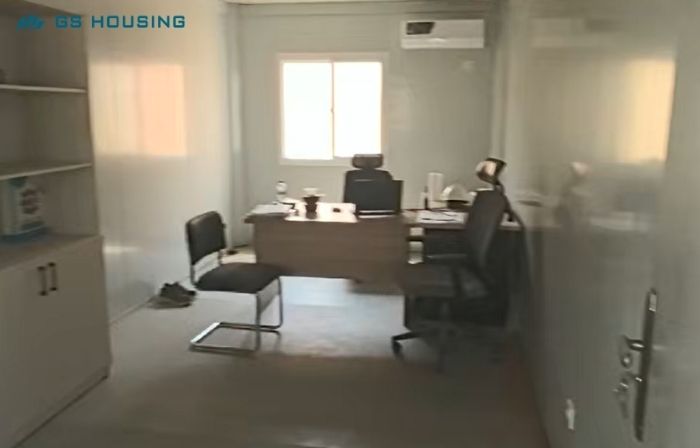
End Use: All 182 modules were utilized to build the camp accommodation, including temporary dormitories for construction workers; office space for the project management team; a site restaurant and laundry facilities; as well as staircases and corridors connecting various functional areas. After the basic facilities (government buildings, schools, and hospitals) of the new city are built, the detachable container modules can be disassembled and moved to other construction sites for reuse, which is in line with the circular economy concept.


Product Unit Details: 182 Sets Composition
Typical module types include, although the final configuration is dynamically adjusted according to on-site requirements:
|
Module Type |
Quantity |
Function |
|
Accommodation Module |
100 |
Single/double room, including bed, storage cabinet, desk, and private bathroom |
|
Office Module |
30 |
Open-plan office area or individual cubicle, equipped with power and low-voltage interfaces |
|
Dining Room Module |
15 |
Capacity for 50-80 people simultaneously, with a reserved kitchen exhaust interface |
|
Laundry Room Module |
6 |
Industrial washing machine/dryer water supply, drainage, and electrical wiring reserved |
|
Staircase Module |
16 |
Double-layer module connection, galvanized steel staircase handrail |
|
Corridor Module |
15 |
Enclosed passageway connecting various functional areas, 1.5m wide |
All prefab module sizes are based on standard container modules for easy land transportation and hoisting.
FAQ – Common Questions
Q1: Will these modular units be able to function in the harsh winters of Uzbekistan?
A: Yes. The rock wool sandwich panels are usually 50-100mm rock wool, and the thermal conductivity is as low as 0.040 W/(m·K). With module gap sealing strips and double-glazed windows, the indoor temperature can be kept above 15°C with a small electric heater or a fuel-fired fan heater, for Tashkent's winter conditions of -10°C to -15°C. GS Housing can customize to increase the wall panel thickness or add an insulation layer if the actual project area has more stringent requirements.
Q2: How are the modules carried? How far is it from Foshan to Tashkent?
A: Typically a multimodal mode of transport is used which combines road and rail: modules are loaded at the factory in Foshan and shipped to Xi'an / Urumqi then transported via the China-Europe Railway Express via the Khorgos border crossing, through Kazakhstan, before arriving at the local storage yard in Tashkent. The total transport time is approximately 20-30 days, the costs are reduced by about 40% in comparison with pure road transport and it is less weather-dependent.
Q3: What special equipment or skilled workers are required for installation after the modules arrive on site?
A: The primary equipment is a truck crane. A typical module weighs 2 to 5 tons and a 25 ton crane will do the job. The site requires a solid, level foundation (strip foundation or concrete floor) and connections to water and electricity. The skilled workforce consists of 1 crane operator and 4 to 5 module connectors who are responsible for the bolt tightening, the electrical quick-connect plug connection and the sealant application. GS Housing provides installation manuals and remote video assistance; complex projects may require on-site supervision by engineers (extra charges apply).
Q4: What does the warranty cover for the 182 modular houses? How to get compensation
A: Warranty period is 12 months from the date the modules arrive at Foshan Port for loading. Coverage includes:
Structural members: Improper peeling of galvanized coating, cracks, or deformation of cold-bent steel (not due to overload).
Enclosure system: Delamination of sandwich panels made of rock wool, corrosion through of panels
Electrical system: Factory-installed switches, sockets, and circuit breaker failure during normal use
Not included: Transportation damage (the buyer needs to take pictures immediately after receiving to claim compensation from the logistics company, transportation damage), damage caused by improper use, and malfunction caused by not maintaining according to the manual.
Claims Process: Buyer provides photo/video evidence + description of malfunction. → GS Housing officially confirms it is covered under warranty → Free replacement parts are shipped or deducted from the next order.
Q5: Can these modules be recycled after their 20-year design life?
A: Yes. Galvanized cold-formed steel is 100% recyclable and can be melted down and recycled into new steel, with a recycling value of about 30-40% of the original steel price; the metal panels in rock wool sandwich panels can be stripped and recycled, and the rock wool itself can be crushed and reused as a garden substrate or industrial filler material. GS Housing does not use difficult-to-separate composite materials for design, and the modules can reach a material reuse rate of more than 90%. This is in accordance with Uzbekistan’s green building and circular economy policies introduced in recent years.
Q6. Are there any special certification requirements in Uzbekistan? Do these modules fulfill them?
Q: How does Uzbekistan control imported building products? A: Mainly through the GOST standard. The main parts of GS Housing’s modular units are usually CE or ISO certified and Uzbek customs accepts CNAS laboratory test reports from China


Conclusion
182 Prefabricated Modules, the Foundation of a New City, Modern The Tashkent New City project is not just a simple temporary site camp procurement, but rather a national demonstration of Uzbekistan’s embrace of industrialized construction, green and low-carbon practices, and efficient delivery. The 182 galvanized cold-formed steel modular units are the result of Chinese manufacturing technology and a deep understanding of the Central Asian market. From fire-resistant (Class A) rock wool wall panels, to an 8-degree earthquake-resistant structure design and a 12-month warranty under FOB As Foshan put it, all the details are to answer the same question: how to upgrade overseas prefab campsites from “makeshift” to “quality-oriented”?
Post time: 03-06-26