


Project Summary
At a time of change when a primary school has a need for more teaching space, the problem is not simply to provide more rooms. The temporary facilities need to support daily lessons, provide a comfortable learning environment for children, and integrate with the existing surroundings of the school.
GS Housing delivered a temporary classroom project for Primary School in Zhengzhou, under the coordination of the Zhengzhou District Education Bureau. The project involved the use of 42 flat-pack container units to provide transitional teaching facilities, offering additional capacity for classrooms while meeting the practical needs of a primary school environment.
The project focused on usable interior height, structural reinforcement, natural daylight, corridor enclosure and architectural coordination, rather than turning the temporary classrooms into simple construction-site accommodation. The information shows the adaptation of a prefabricated building system to the specific needs of an educational facility.

Project at a Glance
| Project Name | Primary School Temporary Classroom Project |
| Location | Guancheng Hui District, Zhengzhou, Henan, China |
| Project Coordination | Guancheng District Education Bureau |
| Application | Temporary transitional classrooms |
| Building System | Flat-pack container houses |
| Project Scale | 42 units |
| Contractor | GS Housing |
The Importance of Temporary Classrooms During School Transitions
The traditional building method can provide permanent facilities, but the program may not meet the school’s immediate need for more teaching space. Temporary container buildings are another option if the project needs a more responsive construction approach.
The key is to differentiate a purpose-designed temporary classroom from a standard modular room. Schools need to accommodate children for the length of the school day and need special consideration for interior clearance, daylight, access routes, structural stability and the relationship between classrooms and circulation areas.
The flat-pack container system offered a modular basis for the creation of a transitional teaching space in the Zhengzhou project. The design was then customized to improve the usability and aesthetics of the completed facility, as opposed to a standard knock-down container configuration.
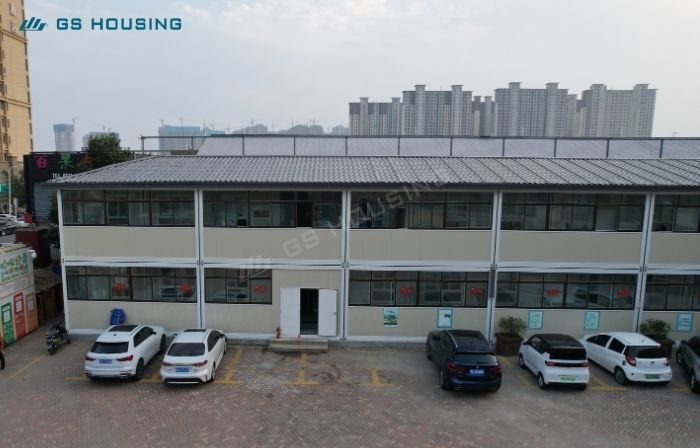
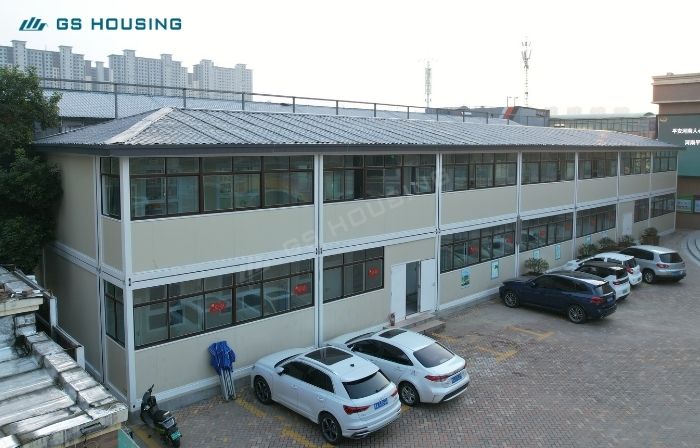
Design Features: Flat-Pack Units in a School Environment
Increase building height to improve interior comfort
The interior proportions define the experience and functioning of a classroom. A room that feels cramped can make daily teaching less comfortable, especially when students and teachers are in it for long periods of time.
GS Housing has raised the total height of the flat-pack container units for this temporary school project. This change in design helped to provide a better environment for classroom use. It also suggests an important consideration for school procurement teams to be aware of: temporary container buildings should be assessed according to their intended occupancy, as opposed to their external dimensions or installation efficiency.
Bottom Frames Reinforced for Structural Integrity
Structural performance is one of the most critical factors of any occupied building including temporary educational facilities. The floor-supporting frame should be considered in relation to the building layout, foundation conditions, installation quality and anticipated service requirements.
For this project, GS Housing also reinforced the bottom frame of the container units. This was a project-specific measure, which was to support a stable teaching environment and to reinforce the building structure.
Structural designs should be verified according to actual building configuration, foundation configuration, local codes and site conditions for similar projects. Reinforcement requirements should be established during engineering design, not as an afterthought during installation.
Higher Windows for Improved Natural Daylighting
When designing classrooms for children, it is important to think about natural daylight. Windows, their height, and location impact daylight penetration and the degree of indoor-outdoor connection.
In the Zhengzhou project, raised window openings were used to improve daylighting access. This change was made in an attempt to make the prefabricated classroom more suitable to its educational function.
The real daylight performance also depends on orientation, external shading, glazing properties, neighboring buildings and depth of the classroom. In adapting modular units to a new school site these factors should be considered in combination.
Thermally broken aluminum frames and full-length corridor windows
Circulation areas play an important role in planning the school. Corridors link classrooms, define movement between spaces, and impact the overall quality of the campus environment.
Full-length thermal-break aluminum windows were specified in the corridor area. This design not only created a more open appearance but also helped to establish a clearer architectural relationship between the enclosed circulation space and classroom blocks.
Thermally-broken aluminum frames have the ability to reduce heat transfer through the frame when compared to traditional, non-thermally-broken aluminum systems. However, its overall thermal performance depends on the complete window assembly, glazing specification, installation details, and local climate requirements.
Coordination of a Gray Four-Slope Roof Architectural
Temporary facility buildings should not be out of place or appear removed from the surrounding campus. The form, color, proportions and external finishes of their roof can influence the degree of compatibility with existing school buildings.
In this project a four-slope roof in gray, antique style was used to make a more coordinated architecture look. The roof design pushed the building away from the look of a row of standard containers toward a more cohesive educational facility.
This is particularly relevant for public sector projects where the appearance of the temporary buildings may be an important consideration as well as functionality and delivery requirements.
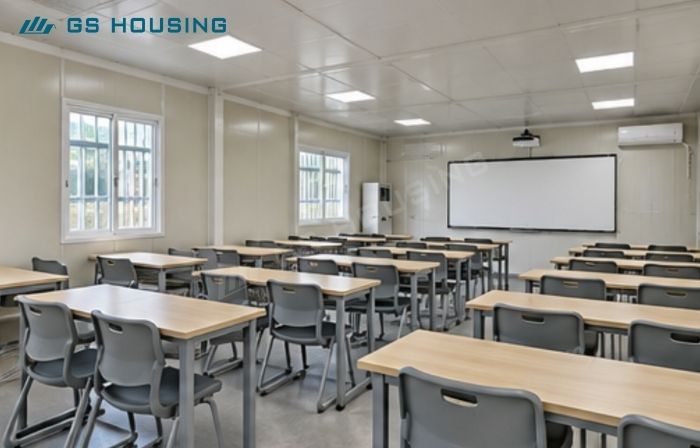

Modular Units as Functional Teaching Space
The value of a temporary classroom building project is in how well the building system accommodates the operational needs of the school. The physical framework is provided by a modular structure, but its success also depends on circulation planning, entrance arrangements, classroom dimensions, ventilation, lighting, electrical services, fire-safety provisions and the suitability of the site.
The temporary classroom project demonstrates the value of adapting a flat-pack container system with some architectural and structural modifications. Increased building height, reinforced bottom frames, higher windows, corridor glazing, and a coordinated roof design were used to address each element of the school environment.
Thus, the project should be viewed not only as the provision of 42 prefabricated units but also as the application of modular construction to a particular education transition requirement.
Why Flat-Pack Container Buildings are Suitable for Transitional School Projects
Flat-pack container buildings may have some practical advantages over more traditional construction methods for schools and education authorities faced with short-term space shortages.
Production in the factory and assembly on-site: The adoption of prefabricated components makes it possible to carry out much of the building work in a controlled production environment with final assembly occurring at the project site.
Flexible building configurations: The modular units can be configured to suit the available land, classroom needs, circulation and future planning of the campus, within limits of structural and regulatory constraints.
Design for a specific project: Modifications to the dimensions, window arrangements, treatments of corridors, external finishes and chosen structural details may be made to meet the requirements of the intended use.
Potential for further reuse: Depending on the foundation, connection system, building condition and local regulations, modular buildings may be able to be moved or reconfigured once the initial temporary need has been met.
Delivery times, total project cost, life span and reuse potential are dependent on site preparation, distance of transport, scope of installation and complexity of design.
Conclusion: Toward a Pragmatic Approach to Temporary Classroom Provision
The Temporary Classroom of Primary School Project shows how the idea of flat-pack container buildings can be adapted to meet temporary teaching needs of an existing school. Coordinated by the Guancheng District Education Bureau, forty-two modular units combined modular construction with targeted improvements to interior proportions, structural stability, daylighting, corridor glazing and appearance of the roof.
For schools considering renovation, campus redevelopment or temporary classroom accommodation, the issue is not simply how quickly a building can be constructed. It is whether the facility as completed meets the educational, structural, and operational needs of the site.
Planning a Temporary Classroom Project?
Contact GS Housing to discuss your project scale, site conditions, classroom layout, technical requirements, and delivery schedule. Our team can help evaluate a suitable flat-pack container building configuration for your educational infrastructure project.
Post time: 06-12-21