


Hotel construction is entering a new phase. Developers are no longer looking only at conventional concrete and steel construction when planning new accommodation. In tourism destinations, remote areas, worker accommodation programs, island resorts, and rapidly developing markets, modular hotel construction is becoming an increasingly practical way to shorten project schedules, improve construction consistency, and respond to changing accommodation demand.
However, a modular hotel construction system is not a single building method.
A compact island resort, a temporary hotel near a construction project, and a permanent multi-story hotel may all be described as “modular hotels,” but they can require completely different structural systems, transportation strategies, and levels of factory completion.
For developers, contractors, and EPC companies, the key question is therefore not simply whether a hotel should be modular. It is the modular construction system that provides the best balance of transportation, construction speed, usable space, building performance, service life, and total project cost.
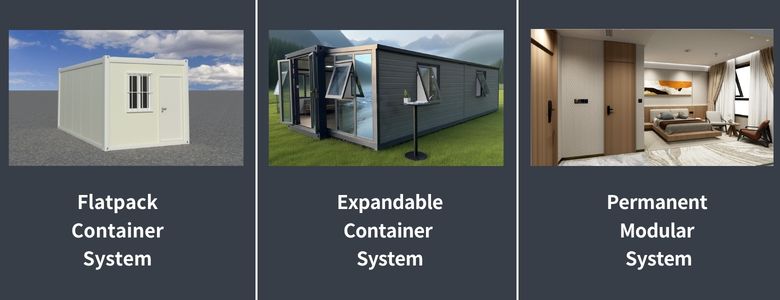
GS Housing approaches prefab hotel construction through three main systems: flat-pack container houses, expandable containers, and volumetric permanent modular buildings. Each has distinct advantages and limitations, making them suitable for different hotel development scenarios.
What Is Modular Hotel Construction?
Modular hotel construction is a building method in which hotel rooms, bathrooms, structural components, or entire three-dimensional modules are fabricated partially or completely in a factory before being shipped to the project site.
The factory environment allows many repetitive processes to be standardized compared to conventional construction. Structural frames, wall panels, insulation, flooring, windows, doors, electrical systems, plumbing, and interior finishes can be made under controlled conditions rather than being fully finished outside.
With modular construction, site preparation and factory production can happen simultaneously. While rooms or modules are being built, utility infrastructure and foundation can be prepared, which can shorten the overall project schedule.
Some hotels are more prefab than others. Before choosing a modular system, a project must consider factors such as road access, shipping routes, room configuration, building height, local regulations, expected service life, and the degree of design customization.
Why Are Modular Hotels Becoming More Attractive?
The biggest advantage of modular hotel construction is not simply speed.
It is the ability to move repetitive construction activities from a variable site environment into a more controlled manufacturing process.
Hotels often have a large number of similar rooms, bathrooms, and corridors. Conventional construction requires these elements to be repeatedly built, inspected, and finished on site. Modular manufacturing can standardize these processes and reduce some of the variability associated with weather, labor availability, and site conditions.
Transportation is equally important.
A modular hotel may require hundreds of rooms, and the cost of moving those rooms from the factory to the destination can have a major impact on project economics. This is why different modular systems exist. A flat-pack hotel prioritizes shipping efficiency; an expandable container hotel prioritizes the relationship between transport volume and final usable space, while a volumetric permanent modular hotel system prioritizes factory completion and long-term building integration.
The right choice depends on your hotel project.

Three Modular Hotel Construction Systems from GS Housing
1. Flat Pack Container Hotel: Optimizing hotel logistics internationally
The flat-pack container hotel is especially suitable for hotel projects where transportation efficiency, standardized rooms, and flexible site assembly are important.
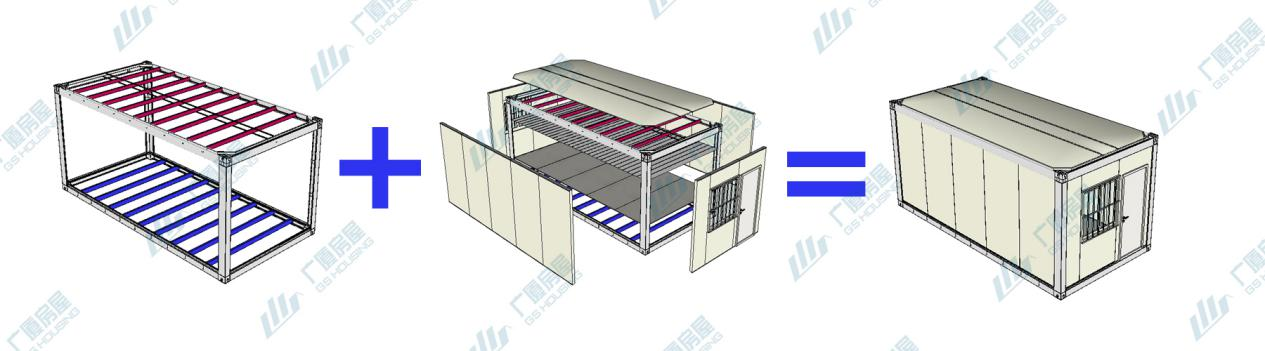
Instead of shipping an entire three-dimensional hotel room, the structural frames, floors, roofs, and wall components are efficiently packed for transportation and assembled on site. GS Housing’s flat-pack system can dramatically cut the volume of transport compared with traditional volumetric modules, which is very valuable on international projects where freight is a major part of the construction budget.
This makes flat-pack construction attractive for overseas resorts, workforce accommodation, roadside hotels, temporary tourism facilities, and mega accommodation projects.
Advantages of Flat-Pack Hotel Build
Flexibility: Individual modules can be designed as guest rooms, corridors, offices, service areas, and other supporting spaces. Standardized units can also be arranged into different layouts based on the site available.
Reusable: Modular units can be assembled, joined, modified, or moved as required by the project. This is good for accommodation projects where the future use of the building may change.
Factory-produced components also contribute to increased dimensional consistency and less variability associated with all site-built construction.
Shipping Efficiency: You can fit more components in a limited shipping volume, which can be especially important when a project requires international delivery to hundreds of rooms.
Flat Pack Hotels Limitations
The main trade-off is in the amount of site assembly.
Flat-pack components will require more work once they arrive at the destination than a finished volumetric hotel module. Installation of structural components, wall systems, MEP connections, and interior elements requires coordination.
Flat-pack construction is therefore especially attractive where transport costs and deployment flexibility are more important than maximizing factory completion.
GS Housing Case Study: Tourist Resort Flatpack Hotel Project in China
GS Housing supplied 44 modular accommodation units for the Shanghai Tourist Resort Hotel Project
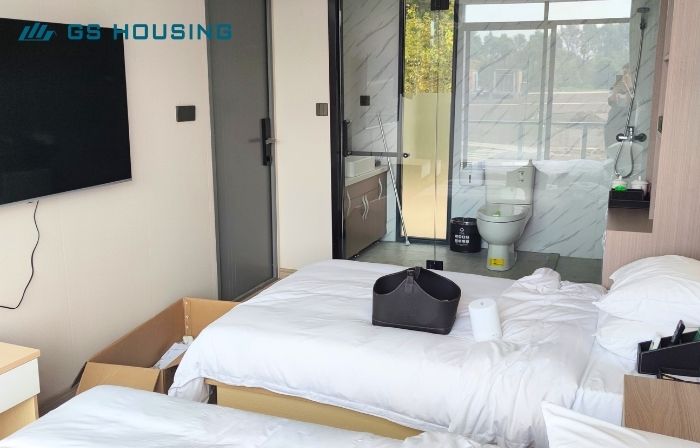
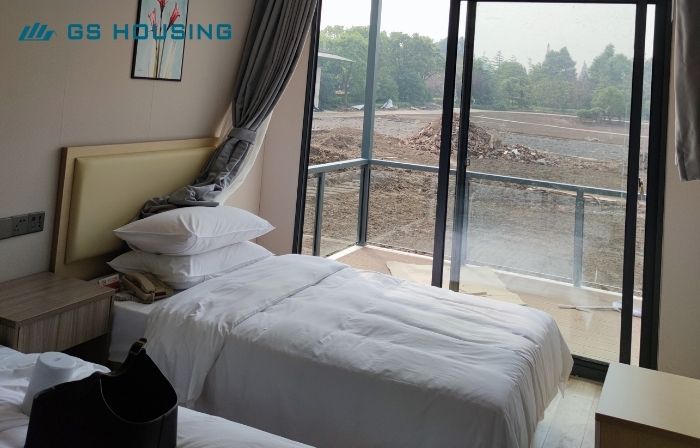
The project was based on standard 3-meter flatpack houses with corridor units that also served as terraces. Instead of thinking of the modular rooms as separate units, the layout merged rooms, corridors, and outdoor spaces into a complete tourism accommodation environment.
The flat-pack hotel rooms were designed to meet real hospitality needs, with beds, storage, air conditioning, television, electrical outlets, and private bathrooms. Also, large French windows were introduced to strengthen the link between the accommodation and the surrounding tourism environment.
Further demands on waterproofing, thermal insulation, corrosion resistance, and structural performance were imposed by Shanghai’s climate. Insulated wall panels and protective surface treatment were used to meet these conditions.
This modular hotel project makes an important point about flat-pack hotel construction: standardized modular rooms don’t have to mean standardized-looking hotels.
With proper planning, modular units can be combined with terraces, landscaping, façade treatments, and different room configurations to create a hospitality environment specific to the destination.

2. Expandable Container Hotel: More Usable Space from a Compact Transport Format
The expandable container handles another problem.
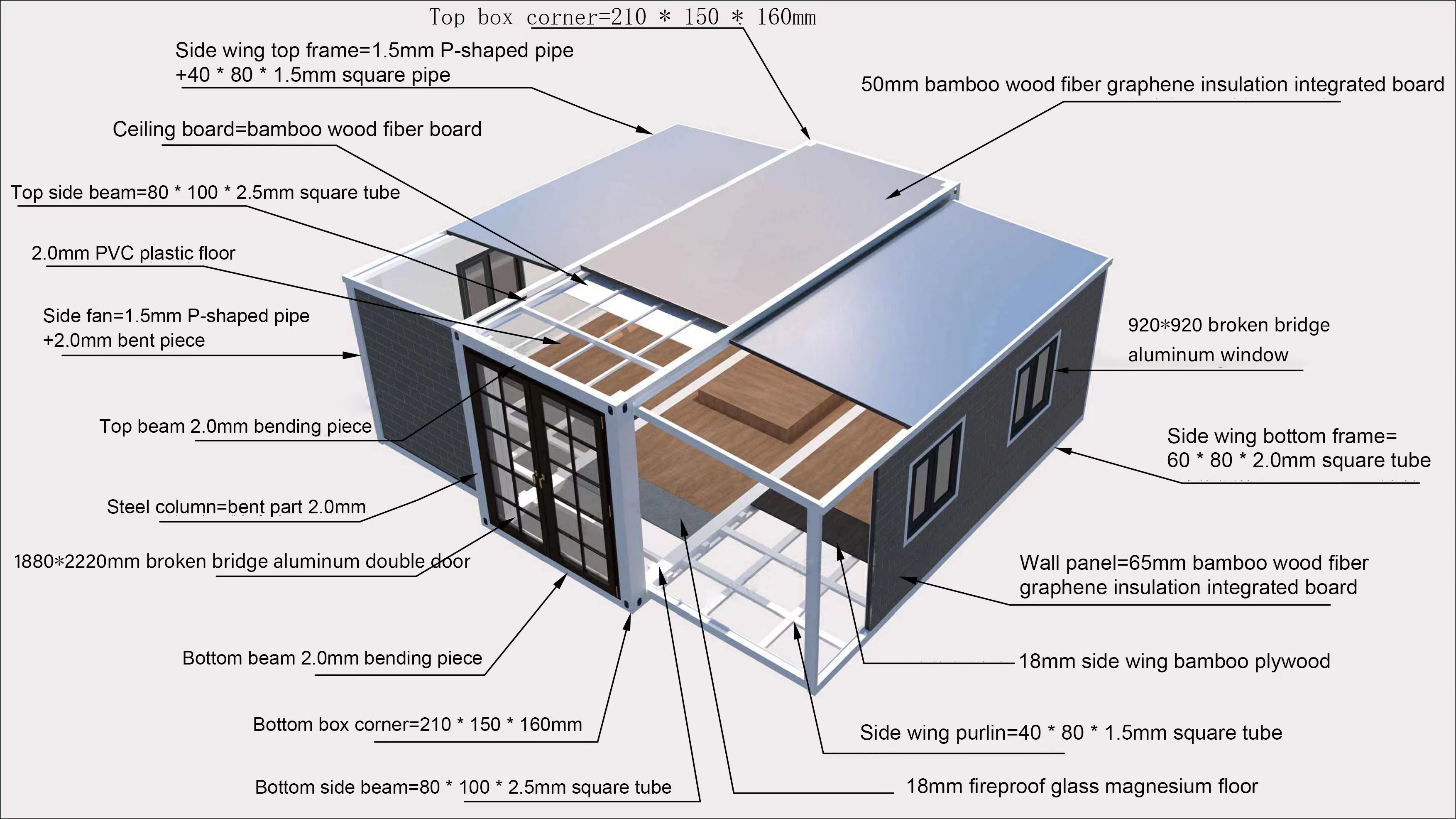
Instead of a flat-pack house, an expandable container is transported in a compact, folded configuration and expanded after reaching the destination.
GS Housing’s expandable container system can boost the usable floor area significantly once deployed. The extra space can be used for bedrooms, living spaces, bathrooms, kitchens, or other living functions depending on the model.
Expandable containers are thus of particular interest to island resorts, remote tourism projects, temporary hotels, seasonal accommodation, and phased hospitality developments.
Benefits of Expandable Container Hotel Units
Higher ratio between transported volume and final usable space: A compact unit can be shipped to a difficult location, then expanded on site, helping to ease some of the logistical challenges of transporting larger completed modules.
Rapid installation: Expandable units are also well suited to rapid installation, as many of the key building elements can be incorporated into the factory-built unit before delivery.
Phased development: A resort does not have to build its entire accommodation capacity at once. In the first stage, fewer expandable units can be developed, with the possibility of adding more as occupancy levels and the demand from tourism justify further investment.
Drawbacks of Expandable Hotel Building
Expandable containers are not the answer for every hotel.
Their structural configuration makes them more suitable for low-rise accommodation, individual guest units, villas,, and small resort clusters than large multi-story hotel towers.
Also, before choosing a system, developers should consider local building codes, wind loads, snow loads, seismic conditions, insulation requirements, and the intended service life.
Expandable containers, therefore, are best seen as a fast and flexible hospitality solution, particularly where site access and transportation efficiency are key constraints.
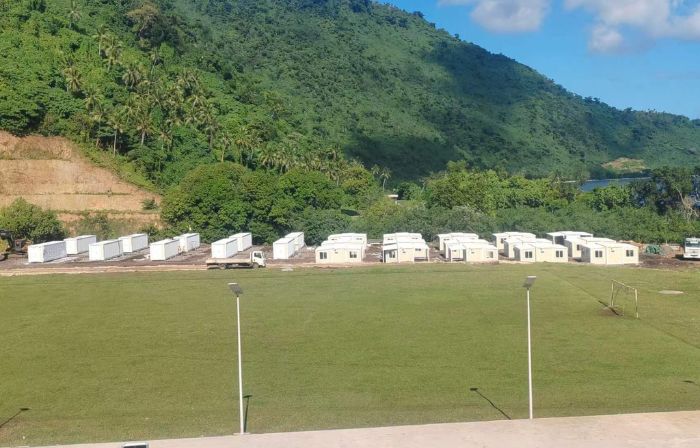
GS Housing Case Study: Vanuatu Expandable Container Hotel Project
The expandable container hotel project consisted of 10 units of 30-foot expandable container houses and 15 units of 20-foot expandable prefab houses, providing accommodation for a tourism resort in an island environment.
The different sizes allowed the lodging to be used for different purposes. The smaller units could be configured as standard rooms; the larger ones could house family units or configurations of vacation-villa types.
The project demonstrates why expandable building is especially beneficial for island tourism. If the road networks, the ports, and the construction resources are limited, reducing the transportation volume of accommodation can be as important as reducing the construction time.
The Vanuatu project also demonstrates how modular hotels can be a scalable tourism investment. Developers are able to build up accommodation capacity in phases and expand the resort as the market develops, instead of building a large traditional resort before demand is proven.


3. Volumetric Permanent Modular Building: A Long-Term Hotel Construction Strategy
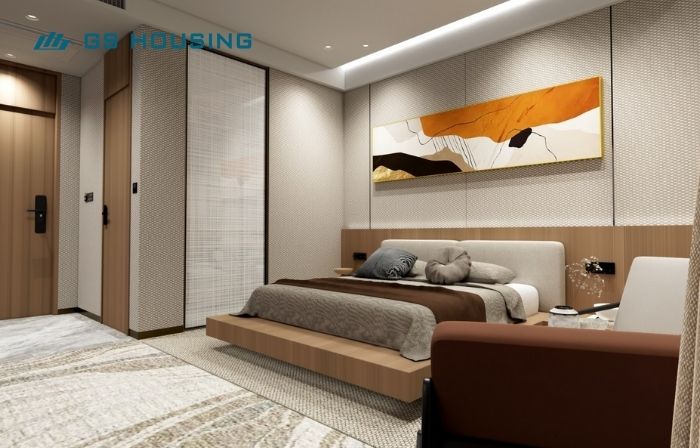
This is a higher level of integration of the factory. Instead of transporting mostly components or expandable structures, complete three-dimensional building modules can be manufactured in the factory and delivered to the site with a high proportion of structural, architectural, and MEP work already completed.
Guest rooms can be built over and over again in a controlled environment while foundations and infrastructure are built on site. Once the modules arrive, cranes can set them in the final building configuration and finish the remaining connections.
Benefits of Volumetric Permanent Modular Hotels
The biggest advantage is the high degree of off-site completion.
The module can integrate bathrooms, wall finishes, flooring, windows, doors, MEP systems and other components before delivery ,depending on the project specification.
This can reduce the amount of repetitive finishing work done on site and increase consistency in production.
Volumetric construction is also especially attractive for large hotel projects with highly repetitive room layouts. The more standardized the rooms, the more factory production can be put to work.
It can also be adapted for permanent buildings and multi-story applications, making it more suitable than expandable containers for many long-term hotel developments.
Disadvantage of Volumetric Permanent Hotel Construction
The big problem is logistics.
It’s a lot more to move a furnished hotel room than flat-packed components. During the architectural design stage, the road width, bridge clearance, maximum vehicle dimensions, shipping containers, cranes, lifting capacity, and transportation routes have to be taken into account.
Once manufacturing has begun, it can be more expensive to change room dimensions, bathroom location or MEP interfaces than making similar changes during a conventional site build.
This is why volumetric modular hotels work best when the developer has a clear design, repeatable room types, and a well-defined project schedule.


How Do the Three Modular Systems Compare?
There is no universal “best” modular hotel construction system.The choice depends on what the developer needs to optimize.
|
Requirement |
Flat Pack Container Hotel |
Expandable Container Hotel |
Volumetric Permanent Modular Hotel |
| International shipping efficiency | Excellent | Excellent | Moderate |
| Rapid deployment | High | Excellent | High |
| Final usable space vs. transport volume | High | Excellent | Moderate |
| Large accommodation programs | Excellent | Moderate | Excellent |
| Temporary hotel | Excellent | Excellent | Good |
| Island resort | Good | Excellent | Possible |
| Permanent hotel | Limited | Limited | Excellent |
| Multi-story application | Limited | Limited | Excellent |
| Relocation potential | High | High | Low |
| Factory completion | Medium | High | Excellent |
| Long-term building application | Project dependent | Project dependent | Excellent |
The table makes one point clear: modular hotel construction should be selected according to the project, not the product name.
What Should Hotel Developers Consider Before Choosing a Modular System?
Project Duration and Service Life
The first question is how long the hotel is expected to operate.
A temporary accommodation facility may not require the same construction strategy as a hotel designed to remain in operation for several decades.
Flat-pack and expandable systems can provide excellent flexibility for temporary, seasonal and relocatable accommodation. Permanent volumetric construction becomes more attractive when the building is intended to become a long-term asset.
Transportation Route
Transportation should be considered before the hotel design is finalized.
A hotel located near a major port and highway network may accommodate larger volumetric modules. A remote project with difficult road access may benefit from flat-pack components or expandable units.
For overseas projects, shipping volume can have a significant impact on total project economics.
Number of Rooms
Repetition is one of the strongest economic drivers of modular construction.
A hotel with 20 highly customized rooms may not gain the same factory-production advantages as a 300-room hotel using several standardized room types.
As the number of repeated rooms increases, the benefits of standardized manufacturing, procurement and quality control generally become more significant.
Building Height and Structural Requirements
Low-rise resorts can accommodate a wider range of modular systems.
Multi-story hotels require greater attention to structural connections, vertical loads, fire protection, seismic performance, staircases, elevators and MEP integration. For such projects, permanent volumetric modular construction may offer a more appropriate platform, subject to project-specific engineering and local regulations.
Opening Schedule
The value of speed should also be measured commercially.
A hotel cannot generate room revenue until it opens.
If modular construction allows the hotel to enter operation several months earlier, the additional revenue generated during that period can be more significant than a small difference in the initial construction price.
This is why developers should evaluate total project economics rather than factory price alone.
Beyond Guest Rooms: Building a Complete Modular Hotel
A successful modular hotel is more than a collection of prefabricated bedrooms.
Reception areas, restaurants, kitchens, lounges, corridors, service rooms, laundry facilities and recreational spaces may require different structural approaches.
This means a modular hotel can combine different construction methods.
For example, standardized guest rooms may use volumetric modules, while a restaurant uses a larger-span structure. A resort may combine expandable accommodation units with conventional landscaping and permanent public facilities. A workforce hotel may use flat-pack accommodation blocks together with modular dining halls, offices and sanitary facilities.
This hybrid approach allows developers to use modular construction where it provides the greatest value rather than forcing every part of the hotel into the same system.
Why opt for GS Housing for Modular Hotel Construction?
GS Housing is not only capable of producing one type of modular hotels. The company can provide various modular construction systems according to the demands of the project.
Flat-pack container hotel offer a practical solution for developers who value efficient international transportation and flexible assembly.
Expandable container hotels are a versatile option for projects that need quick deployment, can be transported in a small package, and need extra usable space after installation.
Volumetric Permanent Modular Hotel buildings offer a more complete permanent construction platform to developers looking at permanent hotels with more factory integration and multi-story potential.
Matching up different modular systems to different environments rather than considering modular construction as a one-size-fits-all product. This is especially relevant for international hotel developers, EPC contractors, and tourism investors, who may be working across very different markets.
Final Thoughts: Choosing the Right Modular Hotel System
The future of modular hotel construction is not about replacing every conventional hotel with one standardized building system.
It is about selecting the right degree of prefabrication for each project.
A tourism resort in an established mainland market may benefit from flat-pack house. An island resort may gain more from expandable containers because transportation volume and site accessibility are critical. A permanent multi-story hotel with hundreds of standardized rooms may be better suited to volumetric permanent modular construction.
For hotel developers, contractors, and EPC companies, the most useful question is therefore not simply:
“How much does a modular hotel cost?”
A better question is:
“Which modular hotel construction system delivers the best combination of logistics efficiency, construction speed, building performance, flexibility and long-term value for this project?”
GS Housing can evaluate these factors and recommend a suitable combination of Flat Pack Container Hotel, Expandable Container hotel, and volumetric permanent modular hotel according to the hotel's location, scale, room configuration, construction schedule, and intended service life.
That is what makes modular hotel construction more than a faster way to build rooms—it becomes a more flexible way to develop hospitality assets.
Post time: 18-08-26