


The challenge for the hospitality industry is always how to grow capacity quickly, cost-effectively, and sustainably without compromising the guest experience. Traditional hotels take 12 to 24 months to build, leaving developers exposed to market fluctuations and missed revenue opportunities. GS Housing’s flat-pack modular hotel buildings offers an attractive alternative: factory-prefabricated components, delivered in compact form and quickly assembled on-site.
What Is Flat-Pack Modular Building?
The third generation of prefabricated building technology is flat-pack modular construction. Flat-pack systems ship building components as compact panels—walls, floors, and roof sections that are assembled on-site—whereas volumetric modular construction involves factory-building whole room units and shipping them as complete 3D boxes.
This method reduces transport volume by 60-70% compared to volumetric modules, making it much more cost-efficient for international shipping and remote locations. A standard shipping container can accommodate up to six flat-pack unit components, whereas only one volumetric module can be accommodated.
GS Housing’s flat-pack container structures are produced as standardized ISO intermodal containers, enabling them to be incorporated into the global shipping infrastructure. The system includes:
Structure Frame: Hot-rolled galvanized steel sheet (SGH440, Q345B) with anti-corrosion treatment
Wall Panels: Non-flammable sandwich panels with insulating properties
Standard Dimensions: External 6055 × 2435 × 2896. Internal 5845 × 2225 × 2780
Design Life: about 20 years
The Process of Assembly
Flat-pack modules arrive in a compact bundle. Assembly is straightforward:
With a team of 3-4 workers, they can put together one full structure in days, a lot faster than traditional construction. GS Housing’s installation teams have set new records for larger projects, installing 882 container units in just 15 days for China’s 70th National Day parade.
Key Applications for Flat-Pack Modular Hotels
1. Tourist Resorts and Eco Lodges
Shanghai Tourist Resort Modular Hotel Project (Year: 2020)
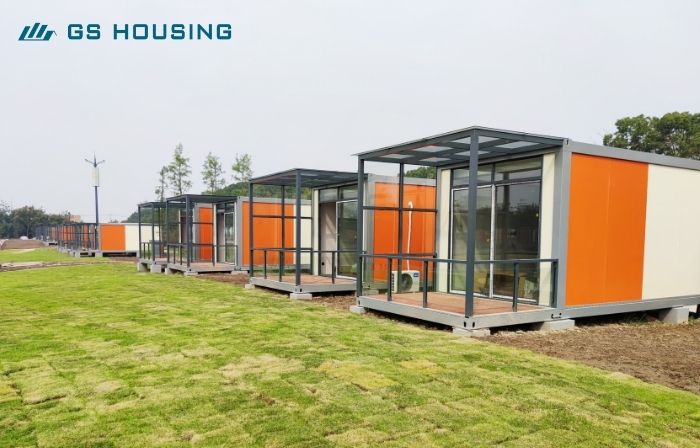
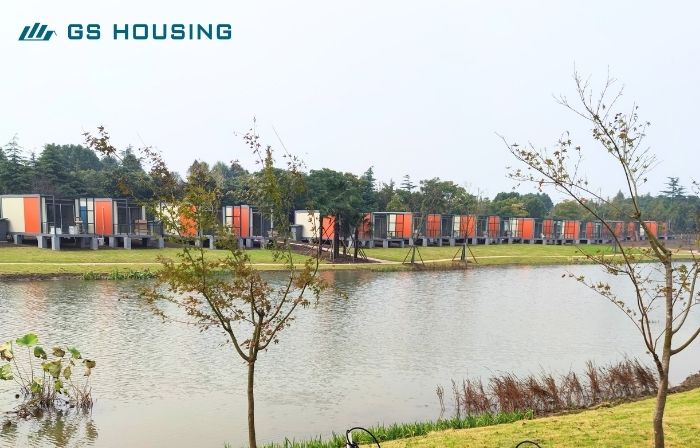
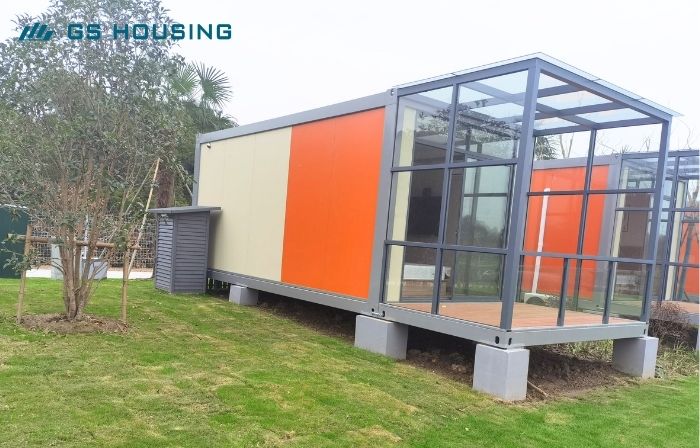
GS Housing’s first tourism destination project demonstrates the system’s applicability to scenic locations. The 44-unit prefab hotel rooms were built with 3-meter standard flat-pack houses with 3-meter corridor terraces, satisfying the subtropical monsoon climate needs of the area.
Climate Resilience: High-end thermal insulation, moisture-proof, and anti-corrosion systems based on electrostatic spraying of graphene powder—20 years of anti-corrosion and anti-fading performance
Safety Standards: Earthquake resistance: Grade 8; Wind resistance: Grade 12
Environmental Impact: No welding on-site, less ecological damage, and construction waste
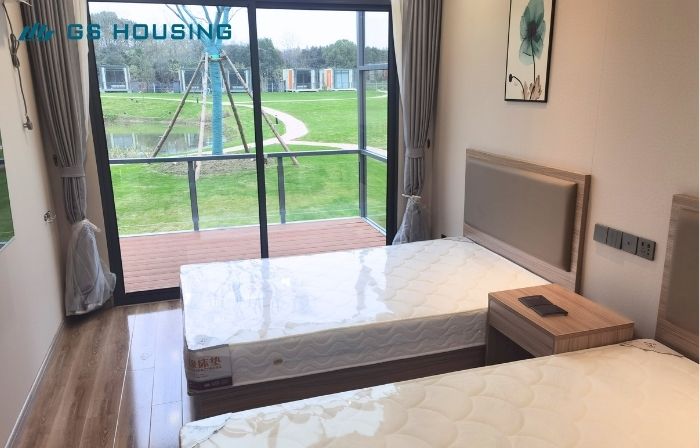
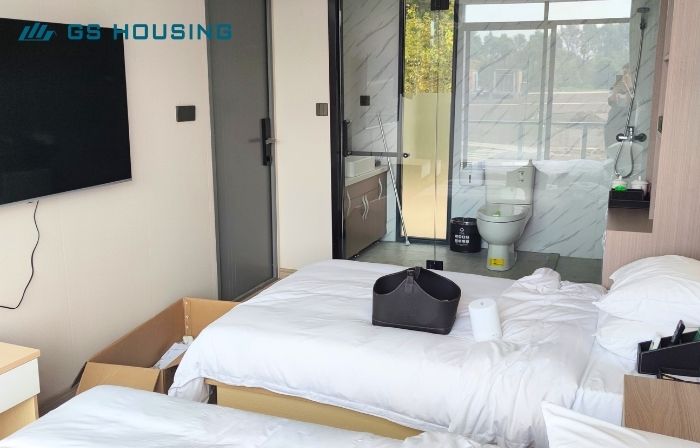
The bedrooms have twin beds, storage, air conditioning, TV, bathroom facilities, and French windows with scenic views. The layout proves modular hotel construction can deliver guest experiences on par with traditional hotels.
Why do resorts choose a flat-pack housing system?
Low ground requirements—no site preparation needed
Installation with minimal damage to the ecology
Easy transport to remote or sensitive sites
Quick deployment to catch seasonal tourism peaks

2. Resorts on Islands and Coasts
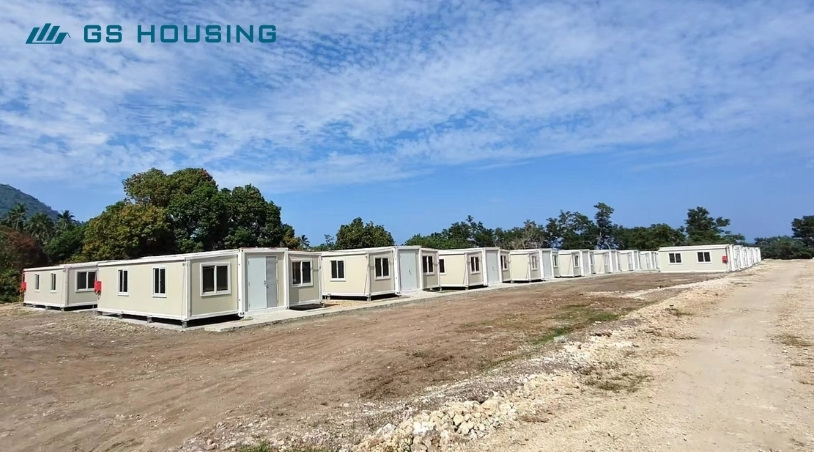
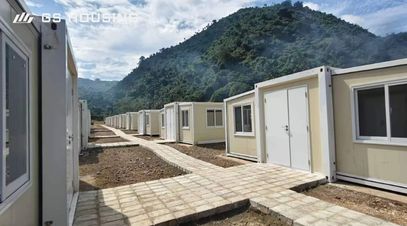
Vanuatu Foldable Modular Hotel Project
This project, undertaken via the Foshan Foreign Affairs Bureau, demonstrates the export potential of the flat-pack technology. The development involved:
10 units of 30-foot expandable container houses (56㎡ each)
15 units of 20-foot expandable prefabricated houses (37 m² each
Technical Characteristics:
| Specification | 20ft Foldable Container | 30ft Foldable Container |
| Expanded Area | 37㎡ | 56㎡ |
| Application | Double standard room, B&B suite | Family suite, vacation villa |
| Features | Budget option for couples | Full kitchen, bathroom, balcony |
The folding design cuts the shipping volume to about a third of the expanded size, for significant logistics savings. The prefab hotel units are constructed according to tropical island climate standards, including waterproofing and corrosion-resistant materials that can withstand Category 12 typhoons.
The main benefit is that the entire prefab hotel complex was commissioned in approximately 30 days from the order date, which would be impossible to achieve using traditional construction methods on remote islands.

3. Worker Accommodation & Remote Camps
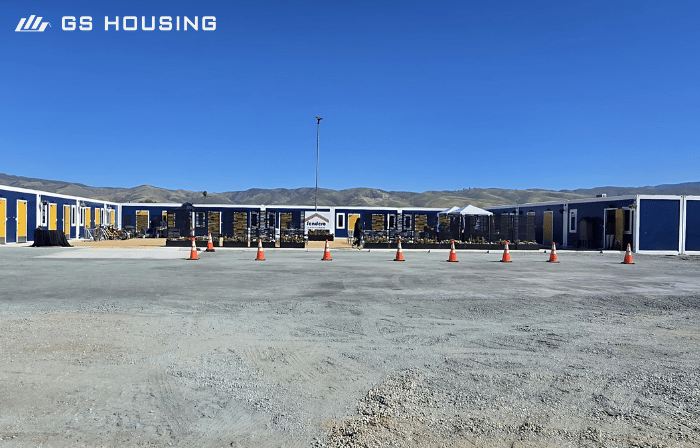
Flat-pack prefab hotels for construction sites, mining operations, and energy projects provide comfortable staff accommodation that can be scaled up or down. These applications typically employ temporary living units with 20-year design lives.
GS Housing’s work on Saudi Arabia’s NEOM megaproject—4,480 sets of prefab houses, including dormitory accommodation, offices, prayer rooms, and sports facilities—is a demonstration of the system’s ability to deliver large-scale workforce housing deployments.


4. Emergency and Transitional Housing
The COVID-19 pandemic demonstrated modular construction's rapid response capabilities. GS Housing built thousands of emergency shelters and 66 modular medical camps within weeks, featuring integrated smart controls for temperature and ventilation.
5. Hotels at Highway Service Areas
Flat pack modular homes provide a fast and economical construction solution for highway hotel service areas, allowing the construction of fully equipped and convenient hotels in just a few weeks to quickly satisfy the overnight needs of long-distance drivers. The flexibility of the modules allows service areas to increase the number of guest rooms or add supporting service spaces, such as convenience stores and restaurants, as needed to adapt to changes in traffic volume.
6. Temporary Events and Seasonal Accommodations
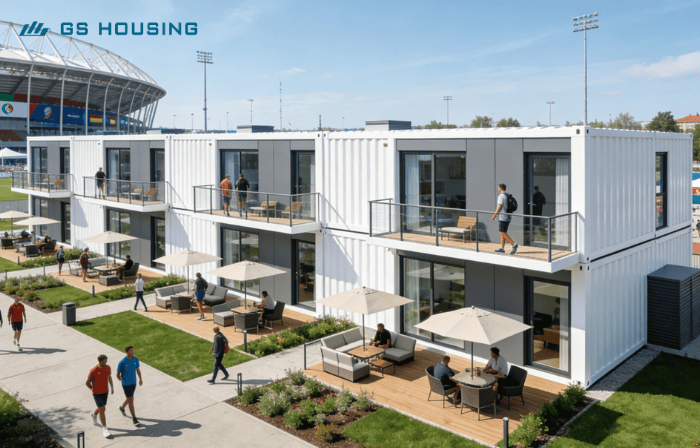
Flat-pack prefab houses can be constructed within days at music festivals or sporting events to create temporary hotel villages, offering comfortable overnight accommodation for thousands of participants and completely changing the basic experience of traditional camping tents. These prefab houses can then be easily disassembled and removed after the event, allowing the area to be returned quickly to its original state with no impact on future land use planning.

Environmental Advantages & Sustainability
Modular hotels made from flat-packs fit with the rising demand for sustainable construction:
Waste Reduction: Factory-controlled production reduces material waste by 70% compared with on-site construction
Less Carbon Footprint: Lower CO₂ emissions thanks to efficient logistics and reduced transport volume
Recyclability: Disassemblable prefab units for moving or recycling at end of life
Energy Efficiency: Insulated sandwich panels reduce heating and cooling needs
Technical Specifications and Performance
Structural Integrity
GS Housing flat pack systems are built to international building standards:
Earthquake resistance: Resistant to Grade 8 earthquakes
Wind Resistance: Grade 12 typhoon resistant (hurricane strength)
Anti-corrosion coatings based on graphene last 20 years, Corrosion Protection
Customization Choices
“Modular hotels are not just ‘container-looking’ buildings, as is often thought. They come with a lot of options for customization:
Exterior Finishes: cladding, glass facades, wood grain coatings, resort-style color schemes
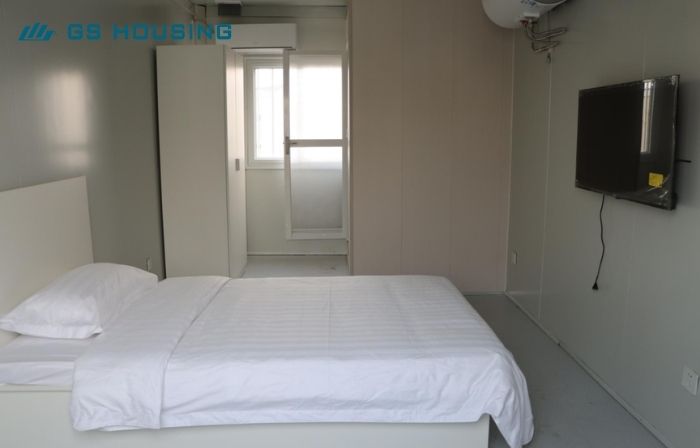
Interiors: Studios, family suites, villas with kitchenettes and balconies
Multi-Story Construction: Temporary Buildings: 3 floors max, permanent Buildings: 8-12 stories

Summary
GS Housing’s flat-pack modular hotel solutions provide a proven alternative to traditional construction for hospitality developers. The system delivers, whether it is a 44-unit eco-resort in Shanghai, a foldable hotel complex in Vanuatu, or workforce accommodation for Saudi Arabia’s NEOM project:
Speed Weeks:not months or years, to complete projects
Cost Savings: 10-20% lower than traditional methods
Quality: Consistency controlled in factory production
Sustainable: Less waste, less carbon footprint, relocatable units
Flexibility: From budget staff housing to high-end resort villa designs
Flat-pack modular technology provides a pragmatic solution for hotel developers experiencing construction delays, rising costs, or challenging site conditions, allowing for fast and sustainable growth.
Post time: 23-06-26