


The provision of reliable accommodation and functional office space in remote and high-altitude regions is a far more difficult proposition than building in typical urban locations. Traditional construction methods can be affected by long transportation distances, difficult weather conditions, limited construction resources, and demanding project schedules.
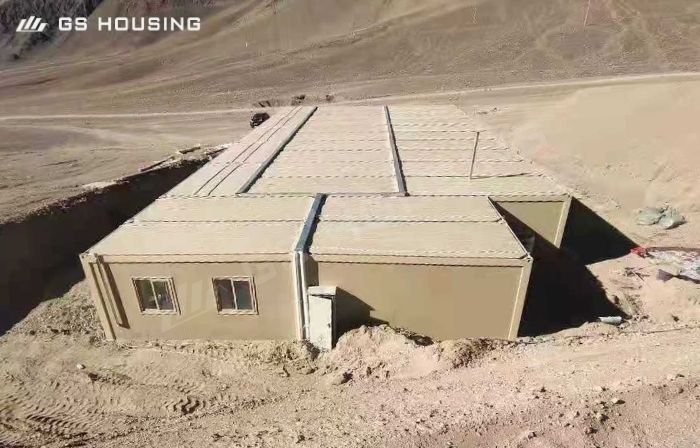
In 2021, GS Housing Group delivered 31 customized portable houses for a remote-area project in Ali Prefecture, Tibet, China, together with China State Construction Technology Engineering Group Co., Ltd. The project is for military accommodation and office facilities and shows how prefabricated buildings could provide a practical building solution in areas where conventional construction is difficult to arrange.
Project Overview
|
Item |
Details |
|
Year |
2021 |
|
Location |
Ali Prefecture, Tibet, China |
|
Project Partner |
China State Construction Technology Engineering Group Co., Ltd. |
|
Supplier |
GS Housing Group |
|
Quantity |
31 units |
|
Product |
|
|
Application |
Military accommodation and office facilities |
|
Project Type |
Remote-area prefabricated building project |
To satisfy the functional requirements of the site, the project used customized portable houses instead of a standard building configuration. The units were designed to meet the needs of both personnel and the office on a daily basis, so the project could not be satisfied with a simple temporary housing installation.
Why Portable Buildings Are Suitable for Remote Military Projects
Military facilities in remote locations often face logistical and construction constraints. A project may require development of usable buildings in an area where skilled labor, construction equipment, and conventional building materials are not readily available.
The construction process is changed by a portable building approach. Instead of doing every stage of construction on the eventual site, major components can be manufactured and prepared in advance. The units can then be transported to the destination and erected with a relatively shorter on-site construction process.
For remote-area projects this can reduce the scope of wet construction work at the installation site and reduce the complexity of coordination between transportation, installation, and commissioning.
Portable military accommodation has another advantage in functional flexibility. One project may include sleeping rooms, offices, meeting spaces, administrative areas, or other support facilities. Portable buildings can be designed to the purpose of use rather than relying on one static building layout.
This makes military portable buildings particularly relevant for projects that require accommodation and operational facilities to be set up within a limited time.


Building in Ali Prefecture: The Importance of Location
Ali Prefecture lies in western Tibet and is distinguished by its high-altitude plateau environment and remote geography. Transportation and site access are critical issues from the beginning of project planning for construction projects in this region.
The challenge, therefore, is not to simply erect a building. The building solution must also consider the method of delivery of the components to the site and their efficiency of assembly and the ability of the completed facility to support its intended users.
This is one reason why portable buildings in remote areas can be practical.
Factory production permits essential building components to be manufactured in controlled conditions before being transported. This allows more of the on-site work to be foundation preparation, positioning, assembly, and installation rather than starting the whole building process from raw materials.
This method can enhance construction organization and decrease the dependence on a large amount of on-site building resources for a project in a remote area such as Ali.
Customizable Portable Houses for Two Different Applications
The Ali project was built around two main applications, military accommodation and office facilities.
These functions have different needs.
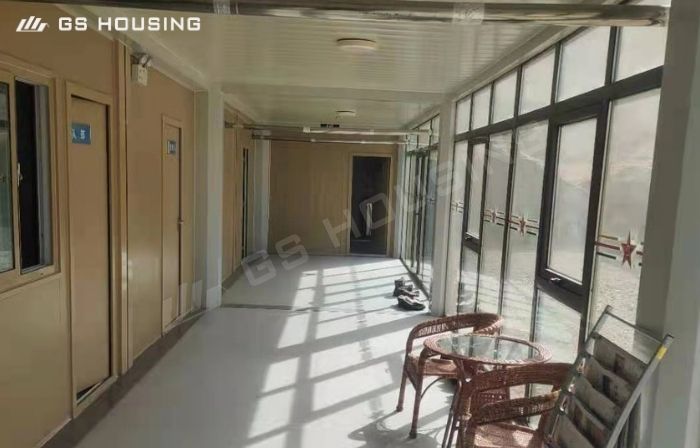
Portable accommodation should provide personnel with an indoor environment that is comfortable and practical. Depending on the arrangement of the building, this can include sleeping areas, circulation space, and other basic living functions.
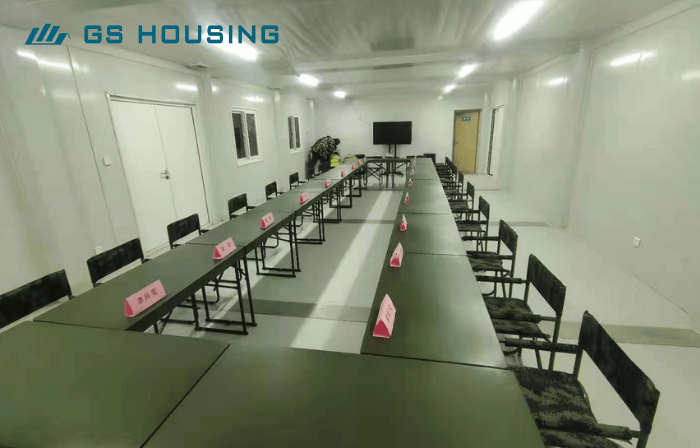
But military office facilities need to be laid out differently in space. Personnel may need work areas, administrative rooms, meeting areas, or other operational functions.
The use of custom portable houses makes it possible to satisfy these demands with a standard portable building system with different internal arrangements.
This method is especially suitable for temporary military accommodation, remote operational facilities, and other projects where buildings are required to perform a specific function rather than follow a standardized residential layout.

From Factory Production to Remote-Site Installation
The value of a portable building is closely related to the way the project is organized before the units reach the site.
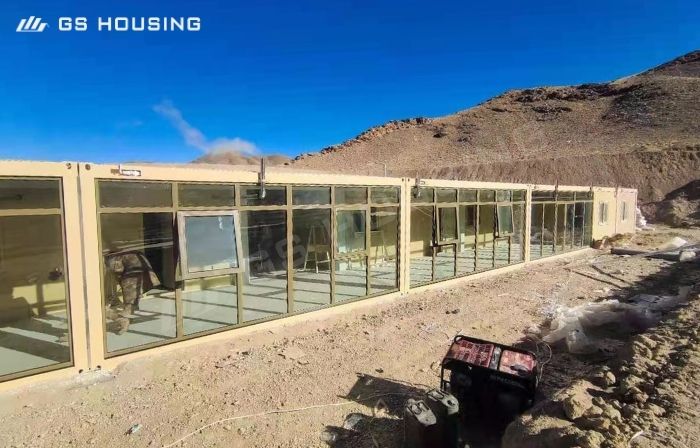
For the Ali project, GS Housing Group supplied 31 customized portable houses. Factory-based production provided an opportunity to coordinate the building components before transportation, helping establish a clearer relationship between manufacturing, logistics, and installation.
A typical workflow for this type of project can be understood in several stages:

This sequence is important for remote projects because construction conditions at the destination cannot always provide the same flexibility as an urban building site.
By transferring a substantial part of the manufacturing process to the factory, prefabrication can make the on-site construction stage more focused and manageable.
Portable Military Accommodation Beyond Basic Shelter
Military accommodation should not be viewed simply as a collection of sleeping units. In a functioning remote facility, accommodation is connected with administration, management and daily operations.
A well-planned portable military accommodation solution can therefore form part of a wider site system that includes:
• Personnel accommodation
• Military office facilities
• Administrative rooms
• Meeting areas
• Staff support spaces
• Storage and service areas
The Ali project illustrates this integrated building approach. Instead of treating accommodation and office buildings as completely separate construction tasks, customized portable units can be planned as part of the same project framework.
This can simplify site organization and provide greater consistency between different building functions.


Why Customization Matters in Portable Military Buildings
Prefabrication does not mean that every building has to look or function the same.
For military and government-related projects, site conditions, personnel requirements, and operational functions can vary considerably. A standard unit may provide the basic structural solution, but customization determines how effectively that unit works in its final application.
Customization can involve building dimensions, internal partitioning, door and window arrangements, electrical systems, insulation configurations, and functional layouts, depending on project requirements.
For this reason, customized portable houses can be more suitable than generic temporary buildings when a project requires a coordinated accommodation and office solution.
A Practical Solution for Remote Construction
One of the strongest characteristics of portable construction is its ability to separate manufacturing from final-site construction.
This is particularly valuable when the project location is far from major manufacturing and labor centers.
For remote portable military buildings, construction planners need to consider more than the building itself. Transportation routes, installation resources, construction sequencing, and site readiness can all influence the final project schedule.
A prefabricated solution can help create a more predictable process because many building components are prepared before they arrive at the site.
The approach does not eliminate the challenges of remote construction, but it can make the building phase easier to organize.
GS Housing Group's Experience in Portable Building Projects
GS Housing Group is a supplier of prefabricated and portable building solutions for a wide variety of applications, including workforce accommodation, site offices, emergency housing, military facilities, mining camps, and other projects requiring rapidly deployable buildings.
The project experience of the company includes a variety of climates, locations, and application scenarios. This experience is especially relevant to projects in which the building requirements are closely related to logistics, site conditions, and project schedules.
What This Project Demonstrates
The Ali project provides a number of practical lessons for future remote area building projects.
First of all, the choice of building should be determined by the location of the project from the very beginning. A solution that is efficient in an urban environment may not be as suitable for a remote high-altitude site.
Second, prefabrication can shift some of the construction burden away from the final site. Factory fabrication allows building elements to be pre-made prior to shipping, thereby decreasing the extent of construction that must be coordinated under remote-site conditions.
Third, when there are multiple functions in one project, customization will matter. Different spatial configurations are required for housing and office facilities, and a flexible prefabricated system can meet these requirements.
And finally, the portable building supply and project logistics should be considered as one system. For remote military facilities, the success of a building project relies on not just the product but also on manufacturing, transportation, installation, and site coordination.
A Flexible Portable Building Option for Remote Military Sites
The Ali project illustrates how portable houses for military accommodation can be adapted to difficult project environments. The project was a combination of prefabricated manufacturing and remote-site construction strategy, and 31 custom units were supplied for accommodation and office applications.
Military portable buildings offer a flexible alternative to full-on-site construction for military organizations and for engineering contractors and infrastructure developers planning facilities in remote regions.
The same portable building approach can facilitate multiple functions from personnel accommodation to office facilities but enable the project configuration to be modified to specific operational requirements.
Portable and modular construction can offer a practical basis for the development of dependable remote facilities for projects where distance, site conditions, and construction efficiency are paramount.
FAQ
1. What's a portable military structure?
Prefabricated buildings provide portable military structures that offer functional accommodation, offices, and support facilities for military personnel. They are shipped to the job site assembled, in whole or in part, for erection and are suitable for remote military facilities and for temporary or semi-permanent applications.
2. Do portable houses make good military accommodation?
Yes. Support buildings like barracks, personnel accommodations, offices, meeting rooms, dining facilities, and storage can be made portable. Interior layouts can be changed to suit the number of occupants and the use of the facility.
3. Can military portable buildings be customized?
Yes, portable military buildings can be customized to fit the floor plan, room function, size, doors and windows, insulation, electrical systems, and other project-specific needs. Hence, the same building system can be used for residential as well as office use.
4. How quickly can you set up a portable military camp?
The length of the construction period will depend upon the size of the project, site preparation, transportation distances, building configuration, and local installation conditions. Prefabricated systems limit on-site construction in comparison to traditional site-built construction because many components are fabricated and prepared prior to delivery.
5. What kind of facilities can be provided in a military camp?
A complete modular military camp may include military barracks, offices, command facilities, dining rooms, medical rooms, storage buildings, sanitation facilities, and recreational or support spaces. Portable buildings can be joined together in a number of different configurations to meet the operational needs of the site.
6. Can portable military accommodation be used at high altitude?
Yes, if you take the environmental conditions into account when you design the building. High-altitude projects such as Ali Prefecture in Tibet need to take into consideration the insulation, structural performance, transportation, foundation, and local climate in the design stage.
7. Can the size of portable military accommodation be increased at a later date?
Yes, in a lot of cases. A modular approach means that if the site requires more accommodation or office capacity, then additional units can be added, provided the original site planning, foundations, utilities, and building system allow for future expansion.
8. Why use portable buildings for military accommodation?
Its main advantages are rapid site erection, factory-controlled fabrication, flexible layouts, simplified project scheduling, and suitability for remote construction sites. They provide a practical alternative for military accommodation and support facilities where conventional construction may be difficult to arrange.
Need Portable Buildings for a Military Project?
Get a customized solution for military barracks, field offices, command centers, medical facilities, and temporary accommodation.
Post time: 31-08-21