


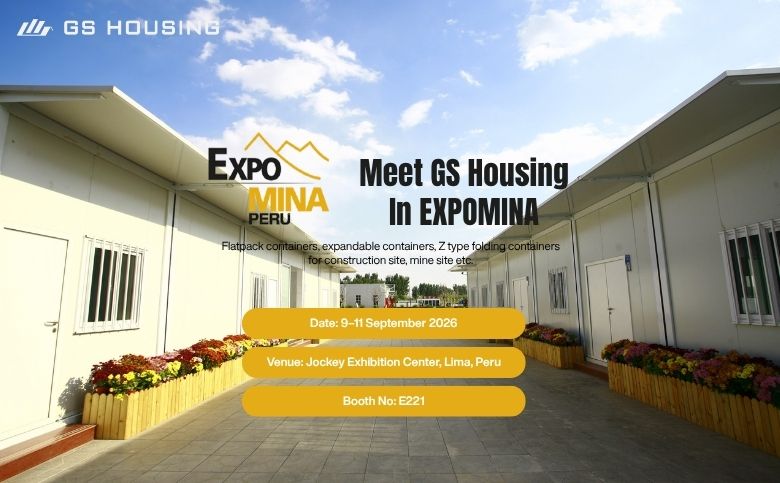
September 9th–11th, 2026 | Centro de Exposiciones Jockey, Lima | Stand: E221
Peru’s mining industry is closely linked to the country‘s geography. Major mining activities extend from the coastal region to the Andes, with projects operating at high elevations, in rugged terrain, and away from major urban centers. Man accommodation is more than simply providing rooms for mining contractors. These buildings have to be transported, installed, and operated in environments where altitude, temperature variations, rainfall, road access, and local community conditions can all affect the project.
EXPOMINA PERÚ 2026 will take place from September 9 to 11 at the Jockey Exhibition Center in Lima. GS Housing will present containerized modular solutions for Peru's mining site buildings, man housing, site offices, and supporting facilities, with a focus on the practical needs of Peru‘s remote mining projects at Booth E221.
Peru Needs a Different Man Camp Building Approach to Its Mining Environment
Peru is not a mining environment. The Andes contain many important mining areas, and Lima is a key center for commerce, logistics, and business. The mining industry in Peru is geographically distributed, with the mining sites concentrated in regions such as Arequipa, La Libertad, Moquegua, Áncash, Junín, Apurímac, and Ica.
For the projects in the highlands, the physical conditions can be quite different from those experienced in Lima.
High-altitude sites can experience strong daytime solar radiation, cold nights, and significant temperature variations. Research on Peruvian mining camps has specifically examined projects in both desert and Meso-Andean climate zones and highlighted the importance of bioclimatic design for worker comfort and safety.
This makes the design of worker accommodation an operational consideration rather than simply an architectural one.
High Altitude Changes What Workers Expect from Accommodation
Workers at a high-altitude mining site may be exposed to conditions very different from those in Lima or other low-altitude cities.
Therefore, a suitable man camp should take into account thermal insulation, indoor air quality, ventilation, exposure to sunlight, heating needs, and the daily cycle of temperature.
The man-camp building envelope is important because good accommodation helps workers recover properly between shifts; this is particularly the case for mining companies.
GS Housing’s containerized modular systems can be fitted with insulated wall and roof assemblies, integrated electrical systems, and layouts adapted to accommodation, offices, and welfare facilities.
It is not to construct a standard building in each place. The containerized modular building specification should be altered to suit the altitude, climate, and operational conditions of the individual mine.


Transportation is a Piece of the Containerized Modular Building Solution
Another challenge for Peruvian mining projects is the transport of construction materials from the major logistics centers to the remote mine sites.
The route from Lima to an Andean project may include long-distance road transportation and then mountainous roads and sections with more difficult access. In some projects, the final delivery stage is as critical as international shipping.
Flat-pack containerized modular construction can have a practical advantage here.
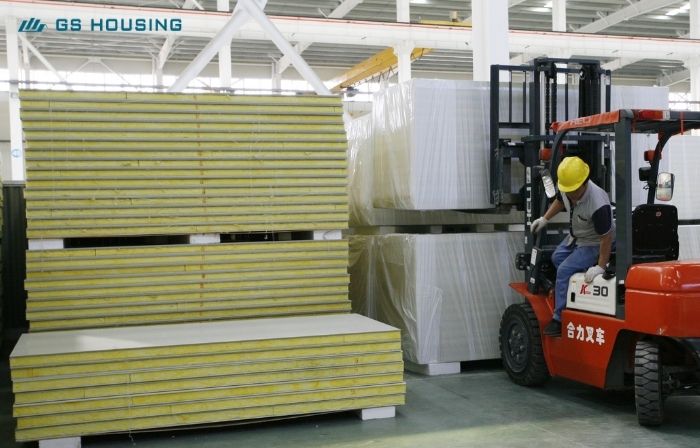
Instead of transporting finished buildings, modular components can be constructed in the factory, packed efficiently, and shipped to the project site for assembly. This allows contractors to schedule transports based on standard modules and a fixed man camp configuration for projects requiring multiple accommodation units.
A Mining Site Camp Building Should Be More Than A Place To Crash
A container workforce camp in Peru may need to support staff working on different shifts, including the mining operators, engineers, maintenance staff, supervisors, and contractors.
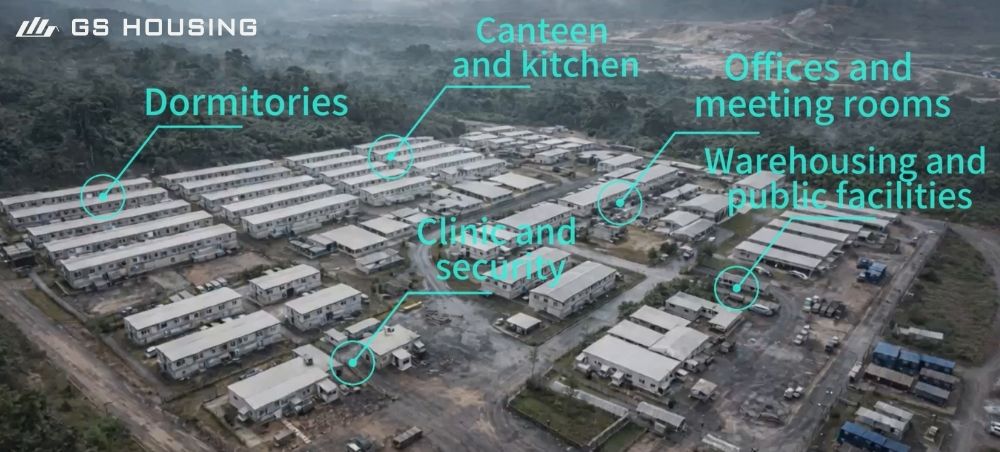
The container camp, therefore, needs to be a small operational community. Mining facility building may include, depending upon the project:
Accommodations for workers in different workforce groups and different shift schedules.
Site offices and meeting rooms for engineering, administration, and project management.
Food and kitchen facilities for workers who may be distant from established urban services.
Facilities for the daily welfare of workers, such as bathrooms, showers, and laundry.
Security, reception, and medical spaces if the project requires it.
These functions can be planned together in a modular system rather than an independent purchase of each building.
Mining Camp Construction in Peru: The Human Factor
Mining development in Peru does not take place in a blank landscape.
Many projects are in areas linked to farming communities, local businesses, and longstanding social networks. Thus, the relationship between mining companies and surrounding communities has become a central element of project development.
Research in Peru highlights the complexity of the relationship between mining, communities, and the environment, particularly in the southern mining corridor. Employment, economic participation, environmental concerns, and communication can shape local views of mining projects.
This means that worker camps need to be considered as part of the wider project environment in accommodation planning.
Well-planned man camps help to organize workforce facilities, improve conditions for daily living, and segregate operational areas from surrounding community areas. It can also help contractors plan accommodation capacity based on actual workforce needs, rather than having to rely on improvised site housing.
Designing for Peru, Not a One-Size-Fits-All Model
GS Housing will present different formats of mining construction at EXPOMINA PERÚ 2026.
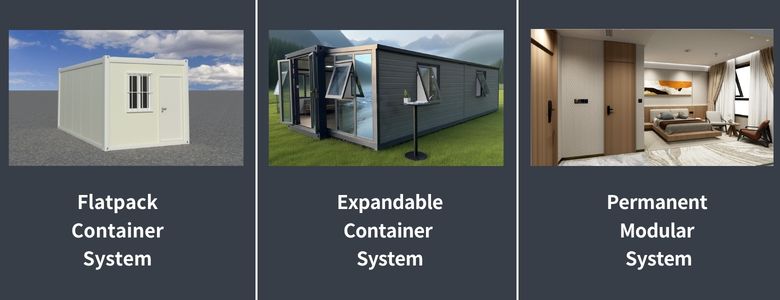
Flat-pack container houses can be converted to worker dormitories, offices, dining halls and supporting facilities and can be combined into larger camp layouts with multiple units.
Z-type folding container houses provide a compact transportation format and can be considered for projects where transportation volume and fast deployment are important.
Expandable container houses provide more usable space after deployment and can be considered for offices, accommodation, or facilities where more internal area is required.
What matters most is that the containerized modular system meets the project requirements.
Thermal performance and worker comfort may be the priority for a high-altitude copper operation. If the construction camp is in a remote location, more focus may be put on transportation and installation. For a larger workforce, standardized accommodation and future expansion may be more important.
What Mining Contractors Need to Consider Before Ordering
Peruvian project teams need to consider more than the unit price before choosing a mining site camp supplier.
The critical questions are
Where is the mine site? What are the conditions at the site?
Altitude, temperature variation, rainfall, wind, ground conditions, and access roads can all influence the building specification.
How are the buildings getting to the site?
International shipping is only part of the logistics chain. The last road trip to an outlying mine can have a big impact on delivery planning.
How many workers will the camp take?
The required capacity should be calculated for different phases of the project, not just for the initial workforce.
Is there space to grow later?
Mining projects can move from exploration to construction and then to production. Accommodation needs may significantly change in this transition.
Is the supplier able to support the complete man-camp layout?
Accommodation, offices, dining, sanitation, and other facilities should be integrated as a coordinated site, not a collection of individual buildings.
Meet GS Housing at EXPOMINA PERÚ 2026
EXPOMINA PERÚ 2026 will take place in Lima, September 9-11, 2026, and will bring together professionals from the Peruvian mining sector and related industries.
GS Housing will be located at:
Event: EXPOMINA PERU 2026
Date: 9–11 September 2026
Venue: Jockey Exhibition Center, Lima, Peru
Booth: E221
The GS Housing team will be meeting with mining companies, EPC contractors, engineering firms, construction contractors, procurement teams, and project developers seeking workforce accommodation and modular facilities for remote mining operations.
For companies developing projects in the Peruvian highlands or other remote mining areas the discussion will be about the real project conditions: location, altitude, climate, transport, workforce capacity, camp functions, and future expansion.
Peru Mining Site Camp Planning?
Success in a mining site accommodation project starts with knowledge of the mine site.
Peru‘s high-altitude operations, long-distance transportation, contrasting climate zones, and close interaction with local communities mean that a standard portable building specification may not be enough. A better approach is to adapt the modular building system to the conditions of the project.


Post time: 25-08-26